Smart Miles
Stop logging miles by hand. Let Smart Miles do it on autopilot.
Automatic GPS tracking, swipe-to-classify, and IRS-ready reports. Free for 40 drives a month.
IRS Raises the Mileage Rate to 76 Cents for the Rest of 2026
The IRS announced a rare mid-year increase: the business mileage rate rises from 72.5 to 76 cents per mile on July 1, 2026. Here's what changes for you.
The IRS has raised the standard business mileage rate to 76 cents per mile for the second half of 2026, up from 72.5 cents. The new rate applies to business miles driven on or after July 1, 2026, under Announcement 2026-11, published in Internal Revenue Bulletin 2026-29. Miles driven from January 1 through June 30, 2026 still use the original 72.5-cent rate.
The New Rates at a Glance
Effective July 1, 2026:
- Business: 76 cents per mile (up from 72.5 cents)
- Medical / Moving: 23.5 cents per mile (up from 20.5 cents)
- Charitable: 14 cents per mile (fixed by statute, unchanged)
The rates for the first half of the year, set in Notice 2026-10, remain in effect for all miles driven before July 1. You can always find the current rates on the IRS standard mileage rates page.
Why a Mid-Year Change?
Mid-year rate adjustments are rare. The IRS normally sets mileage rates once a year in December, and it only steps in mid-year when vehicle costs move sharply. In Announcement 2026-11, the IRS says the revision "results from recent increases in the price of fuel."
The last time this happened was July 2022, when fuel prices pushed the rate from 58.5 to 62.5 cents mid-year, and before that, 2011. A mid-year increase is the IRS acknowledging that driving got meaningfully more expensive, fast.
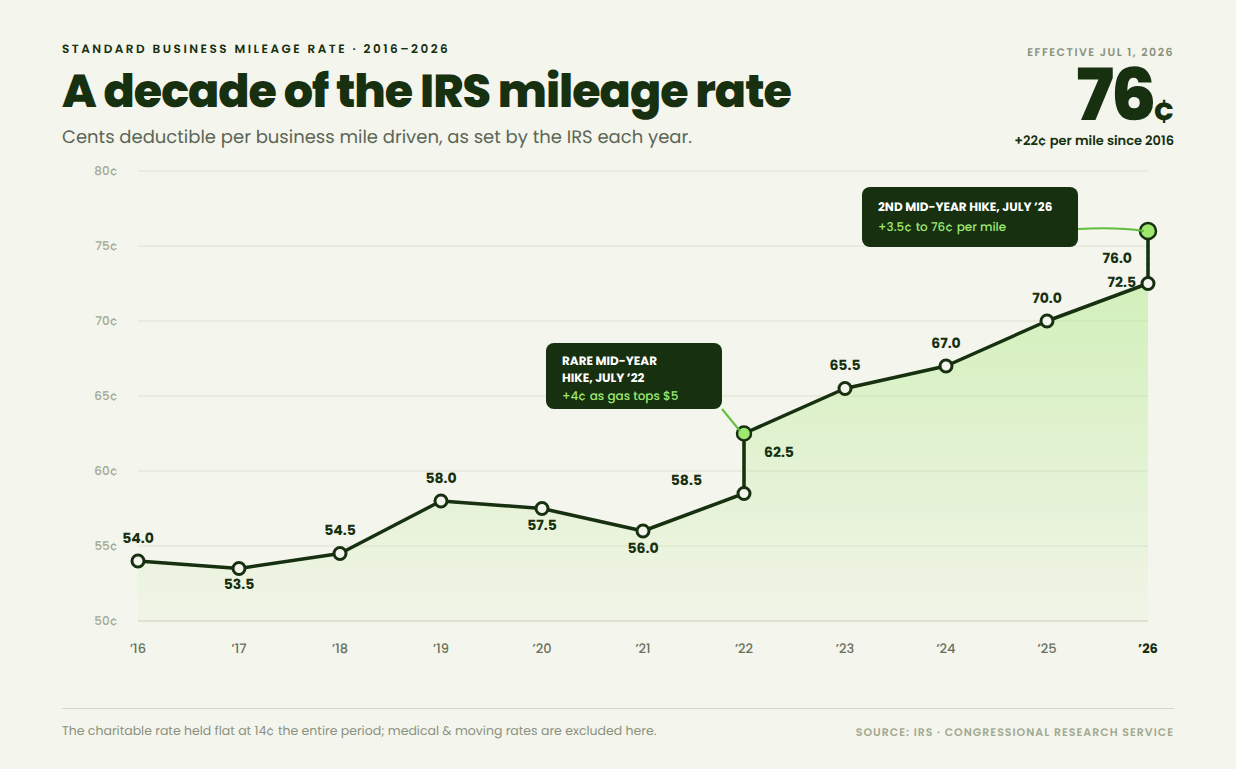
The trend over the decade is unmistakable: the business rate has climbed 22 cents since 2016, with both mid-year jumps landing in years when fuel prices spiked.
What It Means in Dollars
Every business mile you drive from July 1 onward is worth 3.5 cents more as a deduction:
- 5,000 second-half business miles = $3,800 deduction (vs. $3,625 at the old rate)
- 10,000 second-half business miles = $7,600 deduction (vs. $7,250)
- 15,000 second-half business miles = $11,400 deduction (vs. $10,875)
A full-time gig driver logging 20,000 business miles across 2026, split evenly between the two halves, would deduct $7,250 for January–June plus $7,600 for July–December: $14,850 total instead of $14,500. Estimate your own numbers with our 1099 tax calculator.
Two Rates, One Tax Year
The catch with a mid-year change: your 2026 mileage deduction now uses two different rates, and the trip date decides which one applies.
- Business trips before July 1, 2026 → 72.5 cents per mile
- Business trips on or after July 1, 2026 → 76 cents per mile
At tax time you (or your tax software) will total the two periods separately. That makes a dated, per-trip mileage log more important than ever — a single odometer total for the year can't be split correctly. If your log records the date, destination, purpose, and distance of every trip, the split is trivial. See how to prove mileage to the IRS for exactly what your records need.
Smart Miles handles this automatically: every trip is logged with its date, and the app applies the correct IRS rate to each trip based on when you drove it. Your January trips are valued at 72.5 cents, your July trips at 76 cents, with no spreadsheet surgery required.
Medical and Charitable Miles Changed Too
The medical and moving rate jumped from 20.5 to 23.5 cents per mile — a bigger relative increase than the business rate. If you drive for medical care and itemize, those second-half miles are worth noticeably more. The charitable rate stays at 14 cents because it's set by law, not by the IRS. Our guide to charitable and medical mileage rates covers who can claim each.
If You Get Reimbursed by an Employer
The IRS rate is also the ceiling for tax-free mileage reimbursement. Employers who reimburse at the IRS standard rate can move to 76 cents per mile for business trips on or after July 1, and the reimbursement stays tax-free to the employee. Note the timing rule in the announcement: the new rate applies to allowances paid on or after July 1, 2026, for expenses incurred on or after that date. If your employer reimburses your driving, it's worth confirming they've updated their rate.
What You Should Do Now
- Keep tracking every trip. The rate change is applied per trip date, so complete records matter more, not less.
- Don't average the year. Using one rate for all of 2026 will either shortchange you or overstate your deduction.
- Check your reimbursement rate if you submit miles to an employer.
If you're already using Smart Miles, there's nothing to do — the new 76-cent rate is applied automatically to every business trip from July 1 onward, and your year-end totals will reflect both rates correctly. If you're still logging miles by hand, this is a good moment to switch: the rate just went up, and every untracked trip now leaves even more money on the table. Learn more about how much you can deduct for mileage or the 2026 rates as originally announced.
Related articles

Standard Mileage Rate vs. Actual Expenses: Which Should You Choose?
Pick the IRS method that pays you more: the simple 76 cents-per-mile standard rate, or the actual-expense method with receipts. Here's how to decide and how to switch.

Is Mileage Reimbursement Taxable Income?
Mileage reimbursement is taxable by default. It only becomes tax-free when your employer runs an accountable plan that pays at or below the 2026 IRS rate of 76 cents per mile.

Are Tolls Tax Deductible? Yes, On Top of Your Mileage
Business tolls and parking are deductible separately from your mileage, with the standard rate or actual expenses. Here's what counts and what doesn't.
Stop leaving money on the road.
Every mile you don't track is a deduction you don't claim. Start tracking automatically today.