
Smart Miles
Stop logging miles by hand. Let Smart Miles do it on autopilot.
Automatic GPS tracking, swipe-to-classify, and IRS-ready reports. Free for 40 drives a month.
Is Mileage Reimbursement Taxable Income?
Mileage reimbursement is taxable by default. It only becomes tax-free when your employer runs an accountable plan that pays at or below the 2026 IRS rate of 76 cents per mile.
Mileage reimbursement from your employer is taxable income by default. The good news: it becomes completely tax-free when your employer follows IRS rules called an "accountable plan," and the rate is at or below the 2026 IRS standard of 76 cents per mile. Here's exactly how that works, what changes when your employer underpays the IRS rate, and what the rules look like if you're self-employed.
The short answer
- Reimbursement at or below 76¢/mile, paid under an accountable plan: tax-free. Doesn't show up on your W-2. Not taxed.
- Reimbursement above 76¢/mile: only the amount over 76¢ is taxable. The first 76¢ per mile is still tax-free.
- Reimbursement with no accountable plan: the entire amount is taxable wages, added to your W-2.
- You're self-employed (1099): reimbursement isn't really "income" at all, it's a pass-through, and you claim your business miles on Schedule C instead.
For the underlying rate and how the IRS sets it, see our 2026 IRS mileage rate guide. For the self-employed side and which method pays more, see standard mileage rate vs. actual expenses.
What an "accountable plan" actually is
An accountable plan is the IRS's name for a reimbursement arrangement that meets three rules. If your employer's plan meets all three, the money is tax-free to you and deductible to them. If it fails even one, the whole reimbursement becomes taxable wages.
1. Business connection. The reimbursed expenses must be ordinary and necessary business costs you'd otherwise be able to deduct. Driving to client meetings, between job sites, or running business errands all qualify. Pure commuting doesn't.
2. Substantiation. You have to prove the miles with a contemporaneous log: date, business purpose, starting and ending location, and miles. The IRS requires this in writing, usually within 60 days of the expense. A spreadsheet you fill out at tax time won't cut it.
3. Return of excess. If your employer advances you more than the actual business miles, you have to return the excess within a reasonable time (the IRS treats 120 days as the safe harbor).
Most midsize and large employers run accountable plans by default. Small employers, gig platforms, and family-run businesses often don't, which is where the surprise tax bills come from.
What if your employer underpays the IRS rate?
A common scenario: your employer reimburses 50 cents a mile, the IRS rate is 76 cents, and you're out 26 cents per mile on every business drive. The tax treatment splits cleanly:
- The 50¢ you got: tax-free, assuming an accountable plan.
- The 22.5¢ gap: not deductible for most W-2 employees. The Tax Cuts and Jobs Act of 2017 eliminated unreimbursed employee business expenses as a federal deduction through 2025. A handful of states still allow it on the state return.
- Exception: "Working condition fringe" payments your employer makes above their own reimbursement rate, paid under an accountable plan, can be tax-free up to 76¢ total. Ask your employer if they'll run the gap through payroll as a tax-free fringe benefit instead of taxable wages.
For full-time W-2 employees, the practical answer is to negotiate the rate up, not to chase a deduction that no longer exists at the federal level.
Self-employed and contractor reimbursement
If you're a 1099 contractor or self-employed, "reimbursement" is a slightly different conversation. Most of the time, the company paying you isn't reimbursing your mileage, they're paying you a flat fee and you cover your own vehicle costs. In that case:
- The full payment is self-employment income on Schedule C.
- You deduct your business miles at 76¢ each on Schedule C, line 9.
- Your net profit is what gets hit with self-employment tax and income tax.
If a client does reimburse mileage separately, it's not really taxable income, it's a reimbursement of an expense you're about to deduct. You still log the miles and still claim the deduction, and the reimbursement reduces your out-of-pocket cost to zero.
For gig drivers specifically, our DoorDash and gig mileage guide walks through the Uber/Lyft/DoorDash in-app summaries and why they understate your real business miles.
How this connects to your tax bracket
For W-2 employees with an accountable plan and a rate at or under 76¢, this whole topic is essentially a non-event. Reimbursement is tax-free, no W-2 impact, nothing to report. The only time it shows up is if your employer's plan falls short, in which case the overage gets added to your W-2 as wages and is taxed at your marginal rate.
For a self-employed driver in the 22% federal bracket, every 1,000 business miles you log is roughly $725 in deductions, which works out to about $160 in actual federal tax savings on top of the self-employment tax savings. See how much you can deduct for the full math.
How to keep your reimbursement tax-free
If you're an employee who wants to keep your reimbursement outside your taxable income:
- Confirm your employer has a written accountable plan. If they don't, ask them to put one in place. HR or accounting handles this.
- Submit a contemporaneous mileage log. Most accountable plans require you to log trips within 30 to 60 days. A monthly spreadsheet compiled from memory doesn't meet IRS substantiation rules.
- Return any excess within 120 days. If your employer advances you for 1,000 miles and you only drove 900, hand back the 100-mile overage before the deadline.
- Keep your records for at least 3 years. The IRS has 3 years to audit a return, and mileage substantiation is the first thing they ask for.
The easiest way to meet rule #2 is automatic tracking. Smart Miles detects every drive in the background and produces an IRS-ready log with date, route, miles, and purpose, so your employer's accountable-plan substantiation is one export away. Free for up to 40 drives a month, or $5.99/mo ($59.99/yr) for unlimited tracking.
Related articles
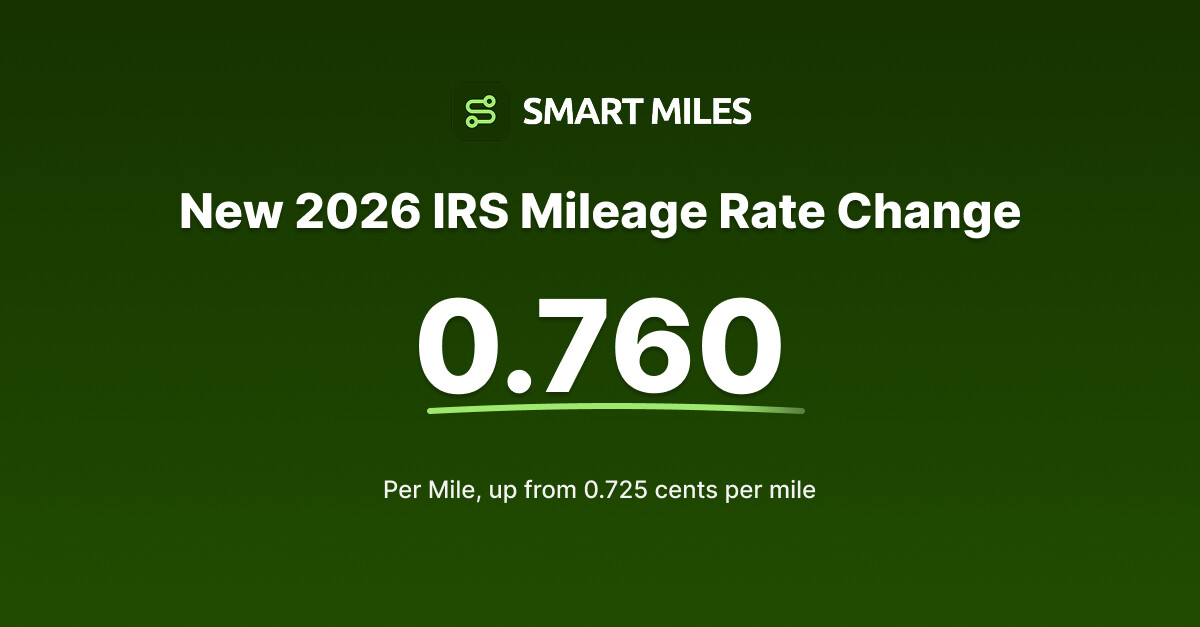
IRS Raises the Mileage Rate to 76 Cents for the Rest of 2026
The IRS announced a rare mid-year increase: the business mileage rate rises from 72.5 to 76 cents per mile on July 1, 2026. Here's what changes for you.

Standard Mileage Rate vs. Actual Expenses: Which Should You Choose?
Pick the IRS method that pays you more: the simple 76 cents-per-mile standard rate, or the actual-expense method with receipts. Here's how to decide and how to switch.

Are Tolls Tax Deductible? Yes, On Top of Your Mileage
Business tolls and parking are deductible separately from your mileage, with the standard rate or actual expenses. Here's what counts and what doesn't.
Stop leaving money on the road.
Every mile you don't track is a deduction you don't claim. Start tracking automatically today.