
Smart Miles
Stop logging miles by hand. Let Smart Miles do it on autopilot.
Automatic GPS tracking, swipe-to-classify, and IRS-ready reports. Free for 40 drives a month.
Standard Mileage Rate vs. Actual Expenses: Which Should You Choose?
Pick the IRS method that pays you more: the simple 76 cents-per-mile standard rate, or the actual-expense method with receipts. Here's how to decide and how to switch.
You have two ways to write off the business use of your car: the IRS standard mileage rate, or the actual-expense method. The IRS doesn't care which one you pick, only that you're consistent. For most self-employed drivers, the standard mileage rate wins on both simplicity and dollar value. The actual-expense method only pays off in a narrow set of situations. Here's how to tell which one is right for you.
The two methods in one paragraph each
Standard mileage method. You multiply your business miles by the 2026 IRS rate of 76 cents per mile. That single number covers gas, oil, maintenance, insurance, registration, and depreciation. You don't track receipts, you just track miles. The catch: you must choose this method in the first year you use the vehicle for business, or you lose the option for that car forever.
Actual-expense method. You track every car cost you actually pay: gas, oil changes, tires, insurance, registration, repairs, lease payments, and depreciation. You add them all up, then deduct the business-use percentage (business miles ÷ total miles). A car driven 60% for business lets you deduct 60% of those costs. The catch: it's paperwork-heavy, and the depreciation rules are brutal.
For the rate itself, see our IRS Mileage Rate 2026 guide. For what to log, see how to prove your mileage to the IRS.
A side-by-side example
Same driver, same 15,000 business miles, same year:
- Standard mileage method: 15,000 × $0.76 = $11,400 deduction.
- Actual-expense method (illustrative): $9,400 in real costs × 60% business use = $5,640 deduction.
In this example the standard rate pays out nearly twice as much. That's why about 9 out of 10 self-employed drivers use it.
When the actual-expense method wins
It only makes sense in a few situations:
- You drive an expensive or gas-hungry vehicle. A heavy-duty work truck, a fully loaded cargo van, or a vehicle that gets 12 mpg can rack up real costs that outrun 76 cents a mile.
- You lease the vehicle. Lessors already bake depreciation into the payment, so the standard rate's built-in depreciation factor overpays you. With actual expenses, you deduct the business share of each lease payment directly.
- You drive very few miles but your fixed costs are high. If you put 3,000 business miles on a car that costs $4,000 a year to insure and register, the standard rate gives you only $2,280. Actual expenses might pay more.
- You started using the car for business after already owning it. If you didn't pick the standard rate in year one, the IRS locks you out, and actual expenses is your only path.
When to absolutely stick with the standard mileage rate
- You drive more than about 8,000 business miles a year.
- Your vehicle is average (sedan, crossover, small SUV) and you don't have unusually high operating costs.
- You'd rather not keep a folder of receipts for every fill-up and oil change.
The first-year lock-in rule
This is the rule that traps people. If you want the option to use the standard mileage rate later, you must choose it in the first year the car is in service for business. If you start with actual expenses, you can switch to the standard rate in a later year, but only by using a straight-line depreciation method for the first few years (a real headache). If you start with the standard rate, you can switch to actual expenses anytime.
The takeaway: if there's a reasonable chance you'll want the standard method down the road, claim it in year one even if year one's actual expenses look slightly better.
What you can claim on top of either method
A few vehicle-related costs are deductible separately under either method, so don't leave them out:
- Business parking fees and tolls. Add them to your Schedule C as a separate line. Our tolls and parking guide covers the rules.
- Interest on a car loan (business-use portion), if you're self-employed.
- State and local property taxes on the vehicle, business-use portion.
A quick decision checklist
- Is this the first year the car is in business use? → Strongly consider claiming the standard rate now to keep the door open.
- Do you drive over 8,000 business miles a year? → Standard rate almost always wins.
- Is your vehicle a normal passenger car or crossover? → Standard rate.
- Do you drive a heavy truck, a van, or a vehicle with unusually high operating costs? → Run both calculations and compare.
- Do you lease the vehicle? → Actual expenses is often the better fit.
- Would you rather not track receipts? → Standard rate, every time.
The one thing both methods require
Whichever method you pick, the IRS requires a contemporaneous mileage log: date, business purpose, starting location, ending location, and miles for every business trip. Receipts alone aren't enough, and the IRS routinely disallows deductions for missing or "reconstructed" logs.
This is where automatic tracking pays for itself. Smart Miles detects every drive in the background and captures the date, route, miles, and purpose for you, so you have an audit-ready log without ever opening a notebook. Try it free for up to 40 drives a month, or get unlimited tracking for $5.99/mo ($59.99/yr).
Related articles
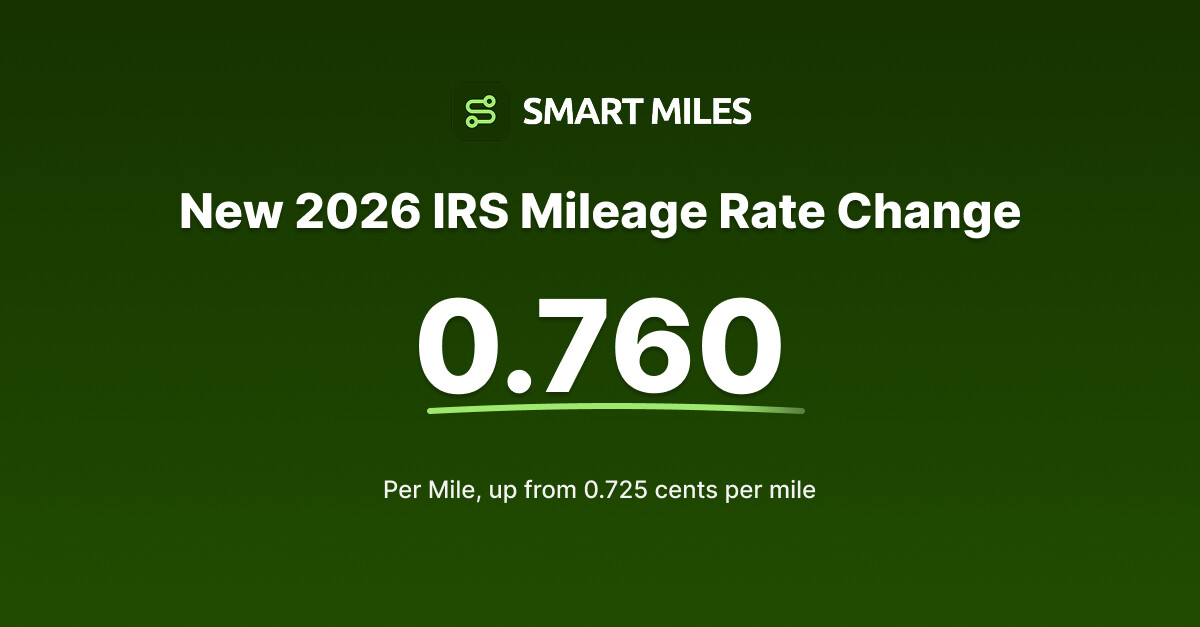
IRS Raises the Mileage Rate to 76 Cents for the Rest of 2026
The IRS announced a rare mid-year increase: the business mileage rate rises from 72.5 to 76 cents per mile on July 1, 2026. Here's what changes for you.

Is Mileage Reimbursement Taxable Income?
Mileage reimbursement is taxable by default. It only becomes tax-free when your employer runs an accountable plan that pays at or below the 2026 IRS rate of 76 cents per mile.

Are Tolls Tax Deductible? Yes, On Top of Your Mileage
Business tolls and parking are deductible separately from your mileage, with the standard rate or actual expenses. Here's what counts and what doesn't.
Stop leaving money on the road.
Every mile you don't track is a deduction you don't claim. Start tracking automatically today.