
Smart Miles
Stop logging miles by hand. Let Smart Miles do it on autopilot.
Automatic GPS tracking, swipe-to-classify, and IRS-ready reports. Free for 40 drives a month.
The Average Mileage Tracker Saves $5,000+ a Year
The IRS gives you 76 cents per business mile as of July 1, 2026. Learn how to track correctly and why most people leave thousands unclaimed.
People who track their mileage save an average of $5,000 or more a year in tax deductions. Yet most people who should be tracking their miles are not, because they don't know they can, forget to do it, or find the whole thing too complicated.
Here's the truth. The IRS gives you 76 cents per business mile as of July 1, 2026. A self-employed person driving 7,000 business miles a year is looking at a $5,320 deduction. Drive 12,000 miles and that climbs to $9,120. Drive 15,000 miles and you're at $11,400. The problem is, you have to track to claim it.
One more thing. The IRS disallows roughly 25% of vehicle-related tax claims due to poor record-keeping. Do not let that be you.
Why the IRS Cares About Your Mileage Log
The IRS gives you 76 cents per business mile, but you need proof to claim it.
The IRS calls it a "contemporaneous record." That means you log each trip close to when it happens, not months later from memory. If you get audited and cannot produce your logs, those deductions disappear.
What the IRS Requires in Your Mileage Log
For each business trip, you need:
- Date of the trip
- Starting location and destination
- Business purpose (client meeting, job site visit, etc.)
- Miles driven
That is it. Sounds simple. But if you are doing this manually for every drive, you will either forget trips or spend hours at tax time trying to piece it together.
The Problem With Manual Tracking
Most people start with the best intentions. They write trips in a notebook, use a spreadsheet, take photos of odometer readings, and keep receipts from parking and tolls.
Then life happens. You are driving to three client meetings in a day. You forget to write one down. Or you log it but cannot remember if it was personal or business. After a year, your log has gaps, inconsistencies, or just guesswork.
The IRS does not care about your intentions. They want records.
Automatic Tracking: The Modern Solution
Automatic mileage tracking apps solve the problem by running in the background. Every time you drive, the app detects the trip, records the route, and classifies it. No manual entry required.
Here is what automatic tracking gives you:
GPS-verified routes. The app knows exactly where you drove, not what you remember.
Automatic classification. Most apps can tell the difference between business, personal, and commuting trips based on locations and patterns.
Real-time logs. Your mileage accumulates all year, so you are never scrambling at tax time.
Audit-ready reports. Export a report with all the details the IRS requires.
How to Choose a Mileage Tracking Method
Here is a quick comparison:
| Method | Time Required | Accuracy | Tax Ready |
|---|---|---|---|
| Paper log | High | Low | Yes, if complete |
| Spreadsheet | Medium | Medium | Yes, if detailed |
| Automatic app | Low | High | Yes |
The best method is the one you will actually use consistently. If you hate paperwork, an automatic app removes the friction entirely.
Setting Up Automatic Tracking
Getting started with automatic mileage tracking is simple.
-
Download a mileage tracking app. Look for one that runs in the background and automatically detects trips.
-
Let it run. After initial setup, the app tracks your drives without prompting. You may need to confirm a trip was business or personal.
-
Review classified trips. Most apps learn your patterns, but review the classifications weekly to ensure accuracy.
-
Export at year end. Generate a tax-ready report with all your business miles, dates, and destinations.
What Trips Count as Business Miles
Understanding what qualifies matters.
Business miles include:
- Driving to client meetings or customer sites
- Traveling between job locations
- Going to pick up business supplies
- Attending work-related events or conferences
Personal miles include:
- Commuting from home to your regular workplace
- Personal errands during the day
- Medical appointments (these use a different rate)
- Charitable driving (also a different rate)
Commuting is a gray area. The rules are complex. Generally, commuting from your home to a regular place of business is not deductible. But if you have a home office as your principal place of business, or you are traveling to a temporary work location, different rules may apply. Tax law around this has changed over the years and varies by situation. We recommend consulting a qualified CPA or tax professional to understand what applies to your specific circumstances.
Record Keeping Best Practices
Even with an automatic app:
- Save receipts. Parking, tolls, and other vehicle expenses can add to your deduction.
- Categorize as you go. Do not let trips pile up unclassified.
- Export monthly. Do not wait until December. Reviewing monthly helps catch gaps.
- Keep records for 3+ years. The IRS generally has 3 years to audit, but records from the year of a large deduction are worth keeping longer.
The Bottom Line
Tracking mileage for taxes does not have to be painful. The IRS standard mileage rate of 76 cents per mile in 2026 means every untracked business mile is money left on the table.
The key is consistency. Whether you prefer a notebook or an app, what matters is that you actually do it, trip after trip, all year long. An automatic mileage tracker removes the biggest obstacle: remembering to track.
Disclaimer: This article is for informational purposes only and does not constitute tax advice. Tax laws change frequently and vary by individual circumstances. For personalized tax guidance, consult a qualified CPA or tax professional.
Related articles
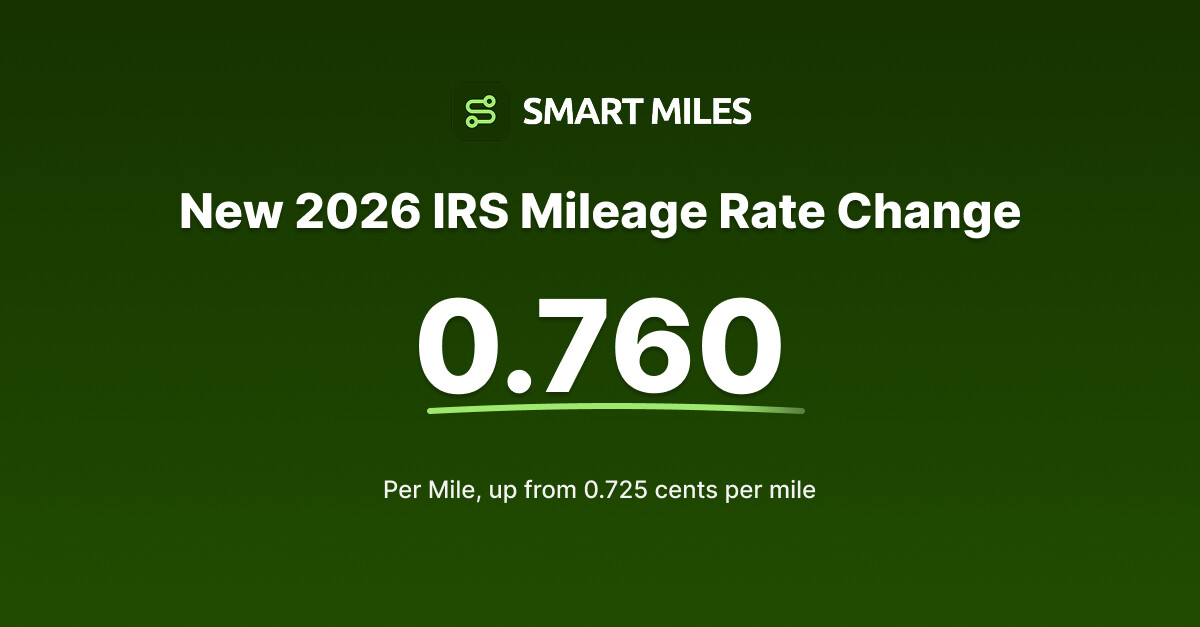
IRS Raises the Mileage Rate to 76 Cents for the Rest of 2026
The IRS announced a rare mid-year increase: the business mileage rate rises from 72.5 to 76 cents per mile on July 1, 2026. Here's what changes for you.

Standard Mileage Rate vs. Actual Expenses: Which Should You Choose?
Pick the IRS method that pays you more: the simple 76 cents-per-mile standard rate, or the actual-expense method with receipts. Here's how to decide and how to switch.

Is Mileage Reimbursement Taxable Income?
Mileage reimbursement is taxable by default. It only becomes tax-free when your employer runs an accountable plan that pays at or below the 2026 IRS rate of 76 cents per mile.
Stop leaving money on the road.
Every mile you don't track is a deduction you don't claim. Start tracking automatically today.